How Better Accounting Turns Construction Profitability Around
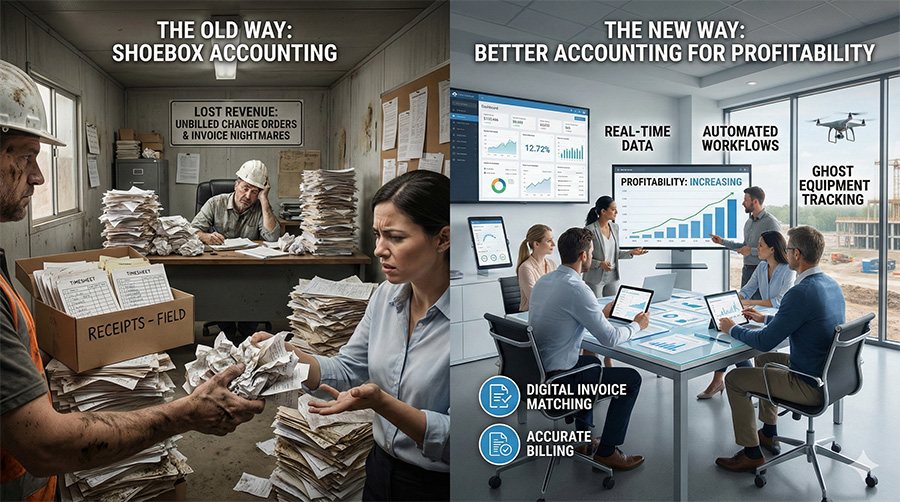
In the construction industry, there is a dangerous paradox: you can be incredibly busy, generating massive revenue, and yet be weeks away from insolvency. This is the “marginal trap.” Many construction companies operate with razor-thin margins—often dipping below 3%—simply because they treat accounting as a compliance necessity rather than a strategic weapon.
The difference between a marginally profitable company and a highly profitable one is rarely the quality of their concrete or the skill of their operators. It is the quality of their data.
Turning a construction business around requires shifting the accounting department from a role of “scorekeeping” (recording history) to “job costing” (analyzing performance). Today, software tools like Vizzn.ca are revolutionizing this transition by bridging the notorious gap between the dusty job site and the pristine finance office.
The Foundation: True Job Costing
In standard business accounting, you track expenses by category: rent, salaries, fuel, materials. In construction, this is useless for profitability analysis. You need to know which job used that fuel, which project burned those man-hours, and which site required that extra load of gravel.
True job costing assigns every dollar spent to a specific project code and phase. When done correctly, it reveals the uncomfortable truths that generic accounting hides. You might discover that while your company made $1 million last year, your flagship project actually lost $200,000, and you were subsidized by three smaller, unglamorous jobs you almost turned down.
However, job costing fails when the data is bad. If field data is late, inaccurate, or missing, your job costing reports are fiction.
The “Garbage In” Problem
For decades, construction accounting has battled the “shoebox” problem: foremen handing in crumpled, muddy paper tickets and illegible timesheets weeks after the work occurred.
-
Lost Revenue: Extra work done on-site (change orders) often goes unbilled because the field team forgot to write it down.
-
Ghost Equipment: Accounting depreciates equipment that is sitting idle, or worse, fails to charge a job for equipment usage, making a project look more profitable than it really is.
-
Invoice Nightmares: Accounts Payable (AP) clerks spend hours matching invoices to delivery tickets, often paying for materials that were never verified.
This is where integrating operations software like Vizzn changes the game.
How Vizzn Empowers the Accounting Team
Vizzn is a construction dispatch and scheduling platform, but its impact on accounting is profound. It solves the “garbage in” problem by digitizing operations data at the source.
1. Automating Accounts Payable with Digital Ticketing
One of the biggest drains on a construction accounting team is verifying trucking and material tickets. Vizzn’s Digital Ticketing feature allows drivers and subcontractors to submit digital tickets that are geo-stamped and time-verified.
-
The Shift: Instead of an accountant manually reconciling hundreds of paper slips against a monthly invoice, Vizzn captures the data instantly. If a load of gravel was diverted or shorted, the system flags it immediately. You stop paying for materials you didn’t receive.
2. Plugging Revenue Leaks (Extra Billings)
Field crews often perform “favors” or extra work for the client—moving a pile of dirt, digging an extra trench—without documenting it. This is “revenue leakage.”
-
The Vizzn Fix: Vizzn’s Interactive Drawings allow site superintendents to snap a photo and pin a note directly to the digital site map the moment extra work is requested. This data flows to the office, alerting the project manager and accounting team to issue a Change Order. You get paid for the work you actually do.
3. Accurate Equipment Costing
A marginally profitable company often treats equipment as a “sunk cost.” A profitable company treats its fleet like an internal rental company. Vizzn tracks the exact movement and status (working vs. parked) of every piece of yellow iron.
-
The Result: Accounting can precisely allocate equipment costs to specific jobs based on actual utilization, not guesses. This ensures your bid rates for future jobs cover the true cost of machine ownership.
Mastering WIP (Work in Progress)
With accurate data flowing from Vizzn, the accounting team can produce a reliable WIP Report. This report tracks “Over/Under Billing,” a critical health metric.
-
The Trap: If you bill $500,000 on a job but have only completed $300,000 worth of work, you are “overbilled.” You have cash in the bank, but it isn’t profit—it’s liability.
-
The Clarity: Accurate WIP reporting warns you if you are “borrowing” from future jobs to pay for current ones. It allows you to recognize profit fade before the job is finished, giving operations a chance to course-correct.
From Scorekeeper to Strategist
When accounting software is fed by accurate field data from tools like Vizzn, the accounting department transforms. They stop chasing paper and start chasing profit.
They can tell the owner: “We shouldn’t bid on highway work anymore; our data shows we consistently lose 5% on those jobs due to mobilization costs. Instead, let’s focus on deep utility work where we average 18% margins.”
That is the difference between surviving and thriving. It isn’t just about working harder; it’s about counting better.